

FIFA's Closing Auction: EI Weekend 3642

On the eve of the final, the World Cup price discovery mechanism is running white hot long before anybody is actually on the pitch…
Exchange Invest is a unique information resource combining the day’s stories in a newsletter for investors in exchanges/financial markets infrastructure.
Exchange Invest was founded by former exchange CEO and author of the first bestselling book of fintech (“Capital Market Revolution!” FT 1999), Patrick Young. Monday through Friday, our daily paid subscriber email discusses the business of bourses of all kinds across the world.
On this day in 2004, Economists and international donors said mismanagement in Zimbabwe by Pres. Robert Mugabe’s regime is behind an annual inflation rate now close to 400 percent.
Last Week
Last week, we analysed 5 Mega IPOs from the dawn of organised stock markets to the renaissance of the space age…
This Saturday
This final weekend, we look at the FIFA World Cup 2026 not simply as a sporting spectacle, but as a live market in probability, liquidity, attention and infrastructure.
Football has always had odds. What is different now is the exchange-style wrapper. Prediction markets have turned this final weekend into a continuously repriced contract stack: the finalists, the favourites and the eliminated ghosts of the bracket, all reduced to tradable probabilities, shifting with goals, injuries, sentiment, liquidity and the grand human delusion that somebody, somewhere, knows what will happen tomorrow.
On the road to the final, Kalshi’s FIFA World Cup Winner market has surpassed $1 billion in volume. With France eliminated in the semifinal (losing 2–0 to Spain) and England eliminated in the other semifinal (losing 2–1 to Argentina), the market has narrowed to a two-team race: Spain leads at 58%, followed by Argentina at 42% (updated through Thursday, July 16th). On the final weekend, that is not a pub argument. That is order flow with a flag painted on it.
Exberry Sponsored Segment

Macro Thoughts
On the final weekend, the World Cup is a macro event with match balls.
It touches consumer spending, airlines, hotels, card networks, media rights, stadium infrastructure, ticketing systems, city budgets and, increasingly, regulated event contracts. The old sports-betting world was mostly about odds before kick-off. The new market is about venue, regulation, surveillance, intraday repricing, settlement and trust. In other words, the plumbing has entered the pitch.
Across Polymarket and Kalshi, AP reports total prediction-market volume of $26.6 billion, up from $9.75 billion last October, with Kalshi accounting for around two-thirds of activity. Polymarket, meanwhile, has returned to the US through QCEX and a CFTC-regulated structure, while its international platform remains crypto-based.
The critical line is simple: prediction markets are not just gambling with better stationery. Done properly, they are price-discovery venues for uncertainty. Done badly, they are noisy casinos with a settlement page. The World Cup final weekend is the perfect laboratory because outcomes are public, settlement is imminent and clear, liquidity is emotional, and every participant thinks he has an edge because he once watched Croatia take penalties.
Recent academic work, “Decomposing Crowd Wisdom: Domain-Specific Calibration Dynamics In Prediction Markets” By Nam Anh Le (arXiv) on prediction markets makes the EI point neatly: prices are useful, but they are not gospel. One 2026 paper analysing Kalshi and Polymarket argues that calibration depends on market type, time horizon and trade size, and that users who treat prices as face-value probabilities can misread them.
Another 2026 paper, “Predicting the 2026 FIFA World Cup With Sufficient Dimension Reduction Of Elo Rating Histories” by Mina Rezaei and S. Yaser Samadi (arXiv) on forecasting the World Cup now reads like the manual for this final weekend, using Elo-rating histories and probabilistic goal models, reminding us that football is now heavily modelled, simulated and repriced before the final is even played. The ball may be round, but the market is increasingly Bayesian.
In BigWorld
On its final weekend, the World Cup is a useful reminder that global markets do not only trade bonds, equities, derivatives and data. This weekend, they are trading attention at its global peak.
Attention is the base asset. Broadcast rights monetise it. Sponsors rent it. Ticketing platforms allocate it. Hospitality packages premium-price it. Prediction markets quantify it. Social media atomises it. Finally, regulators arrive and ask whether everybody understood the terms and conditions before kick-off.
There is also a distinctly Exchange Invest point here: as prediction markets grow, they begin to look more like exchanges than sportsbooks. They require contract design, market supervision, participant access, dispute resolution, risk controls, settlement certainty and public trust. Replace “Team X to lift the trophy tonight” with “Fed to cut in September” and the plumbing starts to look awfully familiar.
A further 2026 paper, “What Prediction Markets Can See: Market Formation, Settlement Legibility, and the Geography of Tradable Uncertainty in Africa and Latin America” by Ade Adegbenro (arXiv) makes another sharp point: prediction markets only list uncertainty that can be clearly worded and settled. Sports sits near the top of that “settlement legibility” stack, which helps explain why football becomes tradable before many civic or institutional risks do.
Thus, on the final weekend, the World Cup is not only a sporting spectacle. It is a giant public demonstration of the marketisation of everything.
Tomorrow, goals become price moves.
Team news becomes an information shock.
The final bracket becomes a volatility surface.
And supporters become, whether they like it or not, probability traders in replica shirts.
On the eve of the final, the World Cup asks: who will win?
The market asks, until kick-off: at what price?
Sponsored by:


Bitcarnage
Ripple’s Fable
Once upon a time, as our latest crypto fable goes, a tale not of fairies but of what was almost the death of a major element of crypto infrastructure: Ripple Considered Shutting Down After The XRP Lawsuit, CEO Reveals (Yahoo Finance).


If you enjoyed this excerpt, you may be interested to know that you can read Bitcarnage every day in Exchange Invest.
Alternatively, if you want to follow Bitcarnage — the daily update on happenings in the world of crypto and digital assets, then you can find Bitcarnage as a standalone on Substack.
Exchange Invest Weekly Podcast

CME Counsel Swap,
Nasdaq’s TransAtlantic Lead,
24*7 Paused?
CME T+2891+ Integration,
& EU Kerfuffles.
Of Interest
As always, a review of interesting reading to provoke thoughts and consideration… Not sure we agree with much of it… but it’s thought-provoking!
As the global sporting community turns its eyes toward the World Cup final, the more important story isn’t the scoreline — it’s the closing auction of a rapidly scaling global probability market. H2 Gambling Capital estimates that roughly $60 billion will be legally wagered through regulated sportsbooks worldwide, up about 70% from the 2022 Qatar tournament. That growth signals more than fan enthusiasm; it reflects the accelerating financialization of major sports.
Beneath the headline handle, the market structure is shifting. A meaningful share of flow is now migrating into secondary markets and derivative-style products, where exposures are repriced continuously rather than simply settled at the final whistle. This is the commoditization of uncertainty: platforms such as Cboe Predict and Kalshi are expanding the venue map for event-linked contracts, turning match outcomes into instruments that trade on spreads, depth, and order flow — not just narrative.
For exchange operators, the signal is hard to ignore. As new venues like the Texas Stock Exchange compete for listings, prediction and event markets are attracting attention and capital toward binary outcomes and short-duration contracts. If liquidity continues to tilt in that direction, traditional exchanges will be competing not only on listings and indices, but on how effectively they can host and clear event-driven risk.
Tomorrow’s final is therefore more than a game; it is a global closing auction in a market with scale, participation, and real-time price discovery. Regulators in Brussels and Washington may still be applying legacy labels, but the product set has already moved beyond simple win–lose binaries. When the whistle blows, the minutes before kickoff will reveal more than sentiment — they will show the live pricing of global probability.
$5.4 billion traded by day 11 of the FIFA World Cup.
Kalshi and Polymarket, two of the biggest names in prediction markets, have turned football outcomes into real-time, tradable probabilities.
While the world watches the football, prediction markets are doing something else: pricing it.
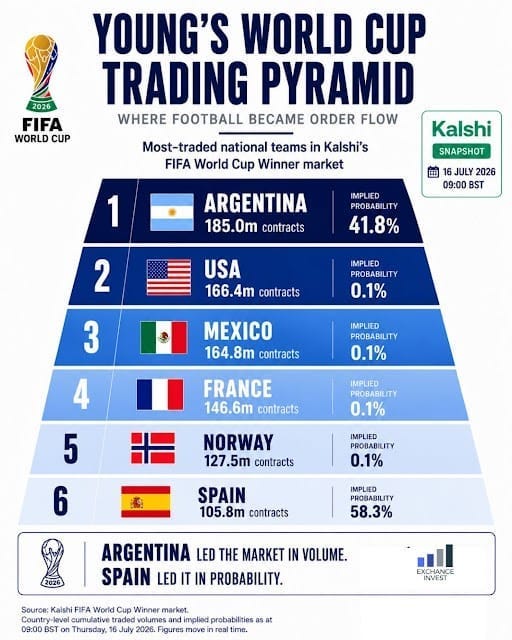
Young’s World Cup Trading Pyramid ranks the six most-traded national teams in Kalshi’s FIFA World Cup Winner market by cumulative contract volume, captured on 16 July.
And the pyramid tells a strikingly unexpected story — not least because the favourite is sitting at the bottom.
Argentina sits at the top with 185 million contracts traded. The USA, Mexico, France and Norway all remain above Spain, despite having already left the tournament.
Spain, meanwhile, sits sixth by volume — but enters Sunday’s final as the market favourite, at roughly 58% implied probability, against Argentina at roughly 42%.
That is the difference between where the market has been and where it thinks the trophy is going.
Argentina led the market in volume. Spain led it in probability.
Now those two markets meet on the pitch.
Last Word
Catch up tomorrow for our Sunday Supplement newsletter.
…If you want to stay abreast of the world of exchanges, then please Subscribe to our Daily Newsletter — free 7-day trial.
Or Subscribe to our Weekend Edition — it’s free.
If you enjoy our multimedia, then please Like / Subscribe to our video channel: IPO-VID In Patrick’s Opinion.